The Bench Guide to British Proof Marks
British proof marks are more than attractive fragments of gunmaking history. They are permanent records of a firearm”s examination under controlled pressure, identifying the proof authority, the type of test applied, and, in many cases, the chamber dimensions and pressure regime for which the arm was accepted. The London Proof House, administered by the Worshipful Company of Gunmakers, and the Birmingham Proof House are statutory testing institutions concerned with barrel and action integrity. Their marks remain essential evidence when assessing a vintage sporting rifle, a military arm, or a classic double rifle.
Under the Gun Barrel Proof Acts, a firearm offered for sale or transfer in the United Kingdom must be in proof. The applicable rules are set out in the official Request Rejected publication. That legal requirement is also a sound practical principle. A rifle may appear excellent externally while having suffered corrosion, excessive wear, a modified chamber, or an incorrectly fitted replacement barrel. Before any firing decision, inspect the marks alongside the current condition of the bore, chamber, locking surfaces, and barrel wall. Proof is a vital safeguard, but it is not a substitute for a competent mechanical examination.
Distinguishing London and Birmingham Proof Houses
The first task is to identify where the arm was tested. London marks commonly incorporate the crowned GP, meaning “Gunmakers” Proof”, together with a view mark, traditionally associated with the inspection of the bore and barrel before final proof. London marks may include the crowned V, or view mark, and other symbols that changed with successive proof laws. On rifles, these symbols are often small and lightly struck, so cleaning should be limited to removing surface dirt rather than polishing away the surrounding metal.
Birmingham proof marks are especially familiar on military rifles and commercial sporting arms. The Birmingham view mark is associated with crossed swords, while the crossed scepters are another characteristic emblem of the Birmingham Proof House. A Birmingham Nitro Proof, commonly abbreviated as BNP, may appear with cartridge dimensions and a pressure figure. The precise arrangement and date code matter because proof marks changed over time. Some Birmingham date or viewers” marks use letters around crossed swords, while later systems adopted circular formats.
- London marks commonly feature the crowned GP, view marks, and symbols associated with the Worshipful Company of Gunmakers.
- Birmingham marks commonly feature crossed swords, crossed scepters, and the crown over BNP on arms receiving nitro proof.
- Location matters because the marks are normally found on barrel flats, the underside of barrel tubes beneath the fore-end, or action faces where the stamp can be read during inspection.
- Later proof marks govern current use when an arm has been reproofed, although they must still be interpreted with the firearm”s present measurements and condition.
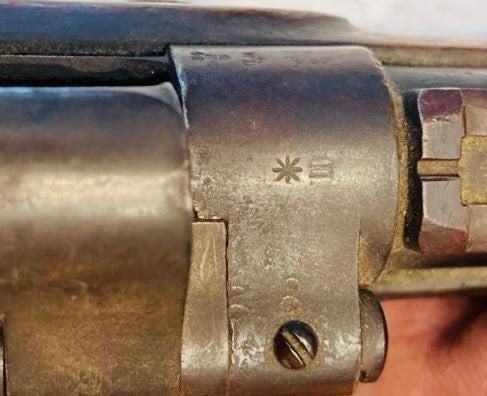
On break-open rifles and combination guns, examine the barrel flats and action face with particular care. On bolt-action military rifles, proof marks may be found on the barrel reinforce, receiver, or other exposed surfaces. Marks can be crowded by military inspection stamps, serial numbers, importer declarations, and later commercial inscriptions. A clear photograph taken before further cleaning is useful, particularly where the marks are shallow or partially obscured.
Evolution of Pressure Regimes from Black Powder to Modern CIP Bar
Early British proofing was developed around black powder, whose pressure characteristics differed significantly from those of later smokeless propellants. As nitro powders became established, proof systems introduced dedicated nitro tests and pressure designations. British figures were commonly expressed in tons per square inch, but the meaning of a particular figure depends on the proof rules and period in which it was applied. A marking such as 18.5 tons on a .303 rifle generally describes the highest mean service pressure for the cartridge, not the full proof load, which was higher.
The historical pressure figures must not be converted casually into modern pounds per square inch. Older systems used crusher methods, in which pressure deformed a calibrated copper or lead element. The amount of deformation was then interpreted as pressure. Modern systems generally use piezoelectric transducers that measure pressure electronically and record a different physical event. A numerical value obtained by one method is therefore not automatically equivalent to the same-looking value obtained by another.
This distinction is particularly important when comparing a vintage British rifle with modern ammunition data. Proof pressure is a controlled test threshold, whereas service pressure is the intended limit for routine ammunition. Chamber length, cartridge design, pressure duration, and the measurement position all influence the result. Modern proofing is coordinated through the international CIP proof standards, but older British marks may reflect earlier crusher-based rules and should be read in their historical context.
| Proof era | Typical marking language | Practical interpretation |
|---|---|---|
| Black powder period | Black powder proof symbols and gauge or bore information | Relates to the pressure and ammunition assumptions of the period, not automatically to modern smokeless cartridges |
| Early nitro period | Nitro proof symbols and tons per square inch | Must be interpreted using the applicable British rules and the marked chamber dimensions |
| Metric transition | Bar figures, sometimes still derived from older crusher procedures | Do not assume that a bar figure has the same measurement basis as a modern electronic reading |
| Modern proof | CIP-aligned metric pressure and chamber markings | Provides a current reference, subject to the firearm remaining unaltered and mechanically sound |
For the owner, the safe conclusion is straightforward. Do not select ammunition merely because a pressure number appears lower after a rough conversion. Confirm the cartridge designation, chamber length, proof status, and applicable standard together. Where the marks are contradictory, incomplete, or difficult to interpret, the rifle should be examined by a qualified gunsmith or submitted to the appropriate Proof House.
Deciphering Military Conversions and Commercial Surplus Stamps
Many British military rifles acquired a second life after leaving Crown service. Lee-Enfields, for example, could be stored, rebuilt, issued overseas, sold as surplus, converted into sporting rifles, or fitted with replacement barrels. Their markings often record several separate stages rather than a single, tidy history. A military acceptance mark indicates inspection for government service, while a factory code or serial-number prefix may identify manufacture. Neither is the same as a later civilian proof.
When a former service rifle entered the civilian trade, it could receive commercial proof at London or Birmingham. A typical Birmingham inscription may include BNP, the cartridge or bore designation, chamber information, and a figure in tons per square inch. On a .303 rifle, a marking such as “.303 2.222 18.5 tons” contains information about the cartridge and pressure regime, but it should not be treated as a complete condition report. It does not confirm that the barrel has retained its original dimensions after decades of use.
- Ordnance inspection marks relate to government acceptance, inspection, storage, repair, or service ownership.
- Factory codes and serial numbers assist with identifying the maker, production period, model, and component history.
- Civil proof marks show that the arm was presented for statutory commercial proof, often after military disposal or conversion.
- Reproof marks may indicate that later work or a change in condition led to a fresh proof examination.
These distinctions prevent a common error: treating every crown, letter, or number as evidence of proof. A barrel date may indicate manufacture or fitting, not the date of the complete rifle. A replacement barrel can carry an earlier date than the receiver, and a rifle may have passed through Indian or other Commonwealth service before returning to the British trade. Commercial markings such as “ENGLAND” can also establish an export history without proving where the rifle was originally made.
The BNP mark is particularly useful, but it should be read with restraint. It identifies Birmingham Nitro Proof, not a guarantee that every modern loading in the same nominal calibre is suitable. The chamber designation must match the cartridge, and the barrel must still be checked for erosion, pitting, enlargement, and wall thickness. Historical provenance is valuable, but sound steel and correct dimensions determine whether firing is responsible.
Practical Inspection Protocols to Verify If a Rifle Remains in Proof
Proof status can be lost when an arm is materially altered after testing. Chamber lengthening, heavy honing, aggressive lapping, rib removal on a proofed barrel assembly, or other work that changes the relevant dimensions may require reproof. Even where an alteration appears minor, the legal and safety consequences should be assessed by a competent professional. A rifle can retain attractive proof symbols while no longer conforming to the condition in which those symbols were applied.
- Record every mark. Photograph the barrel reinforce, flats, action face, receiver, and any export or importer inscription before cleaning or disassembly.
- Identify the latest proof. Separate military inspection marks, factory codes, and date marks from the most recent civil proof symbols.
- Confirm the chamber. Measure or verify the chamber designation with appropriate gauges. A 12/65 chamber, for example, is not a 12/70 chamber, and rifle chambers likewise require exact cartridge identification.
- Measure the bore. Use suitable bore gauges to compare the current internal diameter with the marked or expected dimensions. Enlargement, pronounced throat erosion, or a loose bore can indicate substantial wear.
- Inspect the chamber and locking system. Look for pitting, cracks, gas erosion, damaged locking surfaces, loose bolts, and signs of incorrect headspace.
- Assess the barrel structure. A gunsmith should determine wall thickness where relevant, particularly on thin-barrelled sporting arms and vintage double rifles.
- Stop if anything conflicts. Missing marks, erased inscriptions, contradictory chamber data, or unexplained replacement parts justify professional examination before any firing.
Do not rely on a visual inspection alone. A bore may appear bright while its throat is badly eroded, and a barrel can look sound externally despite internal pitting or reduced wall thickness. The measurement process should be appropriate to the rifle type and carried out with calibrated tools. A military rifle that has been shortened, rechambered, or fitted with a non-original barrel deserves particular caution because its original proof may no longer describe the present configuration.
Regulatory literature does not replace a gunsmith”s technical assessment. The practical principle remains sound across jurisdictions: a firearm taken into the field must be mechanically suitable, correctly chambered, and maintained within applicable legal and technical limits. If a chamber has been lengthened or the bore materially altered, obtain formal advice and determine whether reproof is required before sale or use.
Date marks can help establish sequence, but they should not be mistaken for a complete service history. Birmingham viewers” marks changed across different periods, and some early date codes were not applied consistently. London date marks became useful only in later decades. A reversed or unusual stamp may even reflect a known proof-house stamping error rather than a counterfeit mark. When documentation and metalwork disagree, the physical examination takes precedence over an appealing story.
Preserving Heritage Through Rigorous Firearm Integrity
British proof marks perform two jobs at once. They preserve provenance by showing where and, sometimes, when an arm was examined, while also setting a technical reference for chamber dimensions and pressure. On a military conversion, the marks can reveal the transition from government service to civilian ownership. On a sporting rifle, they can distinguish original proof from later reproof and identify alterations that deserve closer attention.
The responsible collector treats proof as a starting point, not a permission slip. Read every mark, verify the chamber and bore with suitable gauges, inspect the action and barrel structure, and obtain a certified gunsmith”s opinion whenever evidence is incomplete. If doubt remains, submission to the London or Birmingham Proof House is the proper course. Preserving a rifle”s structural integrity is the most practical way to honour the engineering, workmanship, and service history embodied in British gunmaking.